

Something is quietly shifting in the Dutch online gambling scene. Walk through any casino community, poker forum, or Telegram group aimed at players in the Netherlands and you will spot the same pattern: people no longer stick to one casino. They spread their play across two, three, sometimes five or six different platforms. This is not reckless behavior or account abuse. For many Dutch players in 2026, holding several casino accounts has become a rational response to how the local market now works.
This article looks at the reasons behind the multi-account trend, compares the options Dutch players have today, and explains what to consider if you are thinking about expanding beyond your usual site.
The Dutch Online Gambling Landscape in 2026
The Netherlands opened its regulated online gambling market in October 2021 under the Remote Gambling Act (Kansspelen op afstand). Since then, the Kansspelautoriteit (KSA) has tightened the rules year after year. Firm net deposit limits, stricter identity checks, deeper duty of care requirements, and heavy restrictions on advertising have all followed in rapid succession.
By 2026, KSA-licensed casinos operate under one of the strictest frameworks in Europe. On paper this protects players. In practice, it has reshaped how people actually gamble. Recreational players who never had any issue with responsible play now regularly hit limits and restrictions that feel excessive for their situation. And that friction is the trigger for opening a second, third, or fourth account.
Top Reasons Dutch Players Hold Multiple Casino Accounts
Deposit Limits Are Pushing Players to Diversify
Dutch regulations require operators to enforce monthly net deposit limits, on top of any additional limits a player has set themselves. Once you reach the cap at Casino A, you cannot simply lift it without a cooling-off period and additional verification. So you open an account at Casino B and continue playing within your overall budget, only now split across two sites.
For mid-stakes and higher-stakes recreational players, this has become standard practice. It is not about avoiding responsibility. It is about maintaining the same volume of play they used to have on a single platform.
Bonuses Are Better When You Spread Around
KSA-licensed operators face heavy restrictions on the bonuses they can advertise. Welcome offers are modest, wagering conditions are capped, and reload promotions are rare. The real promotional value on any single Dutch-licensed site is therefore limited.
By registering at multiple casinos, players can collect several welcome bonuses over time, join different tournaments, and rotate between platforms based on which one has the strongest offer that week.
Wider Game Libraries and New Providers
No single casino carries every game a player might want. One site has the best live dealer studio, another gets the newest Pragmatic Play releases first, a third specializes in crash games or Megaways titles. Players who care about variety naturally accumulate accounts to reach the games they enjoy most.
Faster and More Flexible Payments
Withdrawal times differ dramatically between operators. Some KSA-licensed casinos process iDEAL cashouts in minutes; others take a day or more. International platforms often add support for cryptocurrencies, Trustly Pay N Play, Skrill, and cards that Dutch-licensed sites do not offer. Players increasingly pick their casino for a session based on which payment method they want to use that day.
Escaping the Rigid CRUKS Framework
CRUKS, the Centraal Register Uitsluiting Kansspelen, was introduced as a self-exclusion tool. In that role, it is genuinely valuable. But the system also frustrates recreational players who never intended to self-exclude and who resent going through repeated verification every time they log in. This has pushed some players toward international platforms that operate outside the CRUKS system entirely.
What Motivates Dutch Players to Register at Multiple Casinos

| Motivation | Share of players citing this reason | Typical player profile |
|---|---|---|
| Higher effective deposit capacity | 41% | Regular sports bettors, mid-stakes slot players |
| Access to better bonuses | 33% | Bonus hunters, casual players |
| Wider game variety | 29% | Slot enthusiasts, live casino fans |
| Faster or alternative payments | 22% | Crypto users, mobile-first players |
| Frustration with CRUKS friction | 18% | Recreational players without exclusion history |
| Sports and casino combined on one site | 15% | Sports bettors who also play casino |
Figures reflect general trends observed across Dutch player communities in early 2026.
Licensed KSA Casinos vs Alternative Options
Dutch players broadly choose between two kinds of platforms. On one side sit the KSA-licensed operators, fully legal in the Netherlands, tax-handled at source, and required to check every player against CRUKS. On the other side sit international casinos licensed elsewhere in Europe or beyond, which accept Dutch players but do not participate in CRUKS. Both categories have real advantages, and increasingly players use them side by side rather than picking one over the other.
Comparison of KSA-Licensed and Non-CRUKS Casinos
| Feature | KSA-Licensed Casinos | Non-CRUKS Alternatives |
|---|---|---|
| Legal status in the Netherlands | Fully licensed and regulated | Licensed abroad (Curaçao, MGA, Anjouan, others) |
| CRUKS enforcement | Mandatory checks on every login | Not connected to CRUKS |
| Deposit limits | Net monthly cap under KSA rules | Player-defined or higher operator limits |
| Bonus generosity | Heavily restricted | Larger welcome offers and ongoing promotions |
| Payment methods | iDEAL, Trustly, bank transfer | iDEAL, crypto, Skrill, Neteller, cards, more |
| Game library | Curated, provider-limited | Broader, includes international-only providers |
| Winnings tax | Handled by operator | Player reports under Dutch tax rules |
| KYC verification | Strict and repeated | Varies by operator |
Why Non-CRUKS Bookmakers Appeal to Dutch Players
Non-CRUKS platforms have become a meaningful part of the Dutch player toolkit in 2026, and it is worth understanding why. For someone who has never had a gambling problem, the constant identity checks, session interruptions, and rigid limits imposed under the Dutch framework can feel disproportionate. International sites offer a more traditional casino experience, closer to what many Dutch players remember from before 2021.
Curated overviews of bookmakers zonder CRUKS help players filter the international market down to platforms that are reputable, accept Dutch customers smoothly, offer proper support, and hold recognized international licenses. This matters because the non-CRUKS space contains both trustworthy operators and low-quality sites. Starting with a vetted shortlist means the choice of casino itself is not another gamble.
The specific benefits that draw Dutch players to these sites include higher deposit ceilings that reflect the player’s own budget rather than a national cap, more generous welcome and reload bonuses with clearer wagering terms, support for cryptocurrencies and other alternative payment methods absent from Dutch-licensed casinos, a broader catalog of slots and live tables from providers unavailable on the local market, and a smoother registration flow without repeated CRUKS verification. Used alongside a licensed Dutch casino, non-CRUKS sites give players real flexibility without cutting them off from the local, tax-handled options they may still prefer for certain sessions.
Tips for Managing Multiple Casino Accounts Safely
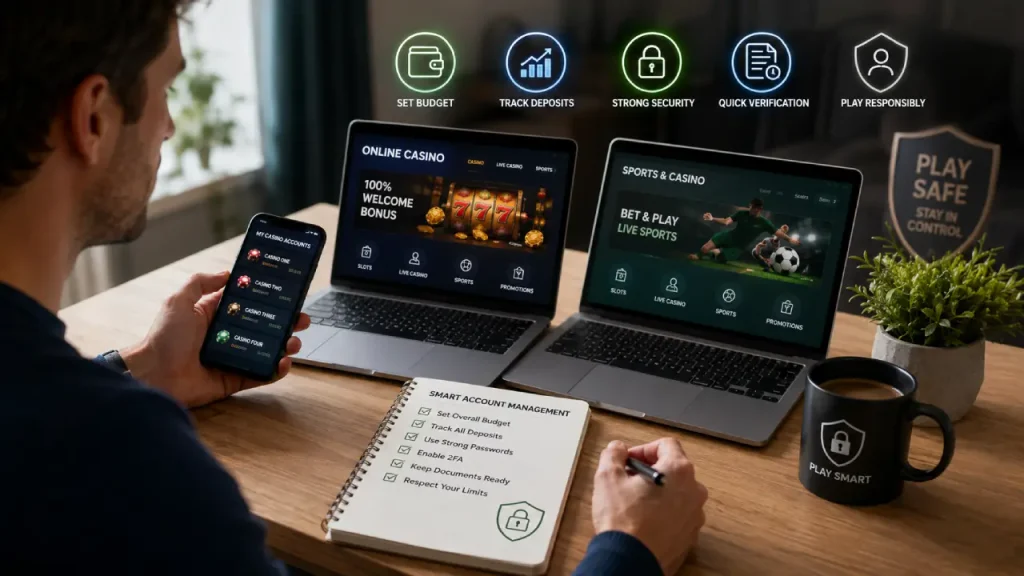
Holding more accounts increases both flexibility and complexity. The players who benefit most from a multi-account setup are those who treat it methodically rather than impulsively.
Set an overall gambling budget first, then distribute it across the platforms you use. Track deposits with a simple spreadsheet or a dedicated app so you can see the true monthly total, not just the amount at each site individually. Use unique passwords for every casino and enable two-factor authentication where the option exists. Keep verification documents ready so withdrawals move quickly across all your accounts.
Most importantly, respect your own limits regardless of how many accounts you hold. The point of the CRUKS system, even for players who find its everyday application frustrating, is to protect against problem gambling. Multi-accounting should not undermine that. If your total play across all accounts is rising rather than staying stable, that is a warning sign worth taking seriously.
What to Look for Before Opening Another Account
Before adding another casino to your rotation, take a moment to evaluate it against a few practical criteria.
| Criteria | What to check |
|---|---|
| License | Verify the regulator (KSA, MGA, UKGC, Curaçao GCB, Anjouan) |
| Reputation | Independent reviews, forum feedback, complaint history |
| Payment terms | Withdrawal times, minimum limits, supported methods |
| Bonus terms | Wagering requirement, game weighting, maximum bet during bonus play |
| Customer support | Live chat availability, response times, language options |
| Responsible gambling tools | Self-set limits, cool-off periods, session reminders |
A five-minute check against these points prevents most of the common problems Dutch players run into with new operators.
The Outlook for Multi-Account Play in 2026 and Beyond
The multi-account trend among Dutch players is unlikely to reverse. If anything, further regulatory tightening at the KSA level will strengthen the incentive to spread play across several operators. The KSA continues to prioritize channelization, meaning keeping players on regulated sites, but its own rules also drive some players away from those sites when limits feel too restrictive.
Three trends look set to continue through 2026. The average number of accounts held per active Dutch player will keep rising. Non-CRUKS international platforms will grow as a complement to licensed Dutch casinos rather than as a replacement. And more sophisticated player tools, such as budget trackers and aggregated bonus watchers built specifically for the multi-account Dutch market, will appear to help players manage the added complexity.
Frequently Asked Questions
Is it legal for Dutch players to have multiple casino accounts? Yes. Players can register at more than one KSA-licensed casino, and there is no Dutch law that forbids playing on international sites. Each operator sets its own terms about creating duplicate accounts at the same brand, but holding one account across several different casinos is entirely normal.
Does multi-accounting help avoid CRUKS? CRUKS applies to KSA-licensed operators. Players who register on non-CRUKS international platforms are not accessing those sites through CRUKS at all. However, anyone who has deliberately self-excluded should respect that exclusion regardless of platform. The purpose of self-exclusion is to protect the player, and switching sites defeats it.
Are non-CRUKS casinos safe? Reputable non-CRUKS casinos hold recognized international licenses, use audited game providers, and have functioning payment systems. Quality varies more than in the KSA-licensed market, which is exactly why using a curated shortlist matters.
Do I need to pay tax on winnings from international casinos? For KSA-licensed casinos, tax on winnings is generally handled by the operator. For international casinos, Dutch players are responsible for reporting winnings themselves. Consult a Dutch tax advisor if the sums involved are significant.
How many casino accounts is too many? There is no single number. What matters is whether you can still track your total spend, still stay within a budget you set in advance, and still walk away when you planned to. If any of those three break down, the number is too high for you.